
How Anti-Cheat Works (Explained Simply in 2026)
How Anti-Cheat Works (Explained Simply in 2026)
If you’re playing any modern online game, there’s one system constantly running in the background:
Anti-cheat software.
But despite how common it is, most people don’t actually understand how anti-cheats work, what they look for, or how they detect players.
This guide breaks it all down in plain English — no technical background needed.
🧠 What Anti-Cheat Actually Does
At a basic level, anti-cheat systems are designed to:
- Monitor your system and game
- Detect suspicious activity
- Prevent unauthorized changes
- Enforce bans when needed
They don’t just look for “cheats” — they look for anything that shouldn’t be happening.
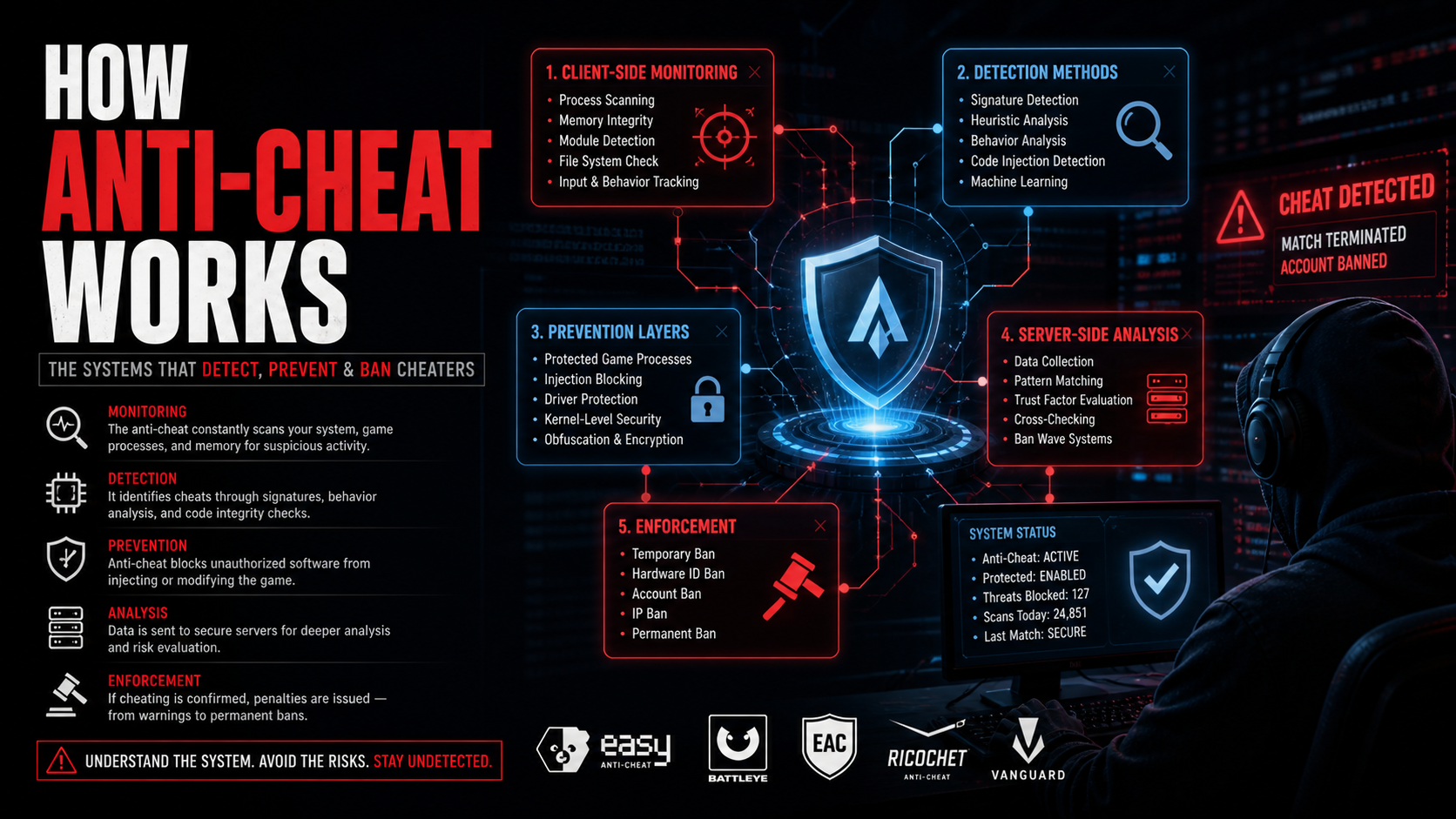
🔍 The 5 Core Parts of Anti-Cheat
Most modern anti-cheats work in layers. Here are the main ones:
1. 👁️ Client-Side Monitoring
This runs on your PC while the game is open.
It checks things like:
- Running processes
- Memory changes
- Loaded files and modules
- Input behavior
👉 If something unusual is detected, it gets flagged.
2. 🧩 Detection Methods
Anti-cheats use multiple ways to identify suspicious activity:
Signature Detection
- Looks for known patterns from previously detected software
- Fast and reliable — but only works on known targets
Heuristic Detection
- Looks for unusual behavior, not exact matches
- Example: strange memory access patterns
Behavior Analysis
- Tracks how the game is being played
- Detects unnatural actions over time
👉 Most detections today are a mix of all three.
3. 🛡️ Prevention Layers
Modern anti-cheats don’t just detect — they try to block things before they happen.
Examples:
- Preventing unauthorized code from loading
- Blocking certain types of memory access
- Protecting game processes
- Obfuscating important game data
Some systems operate at a deeper level to enforce this (like kernel-level protection).
4. 🌐 Server-Side Analysis
Not everything happens on your PC.
Game servers also:
- Analyze player data
- Compare behavior across matches
- Look for patterns over time
This is how systems can detect:
- long-term suspicious activity
- statistical anomalies
- repeated patterns
5. ⚖️ Enforcement (Bans)
Once something is confirmed, action is taken.
Types of enforcement include:
- Temporary bans
- Permanent account bans
- Hardware-based restrictions (HWID)
- Delayed ban waves
👉 Many games use delayed bans so detection methods aren’t exposed immediately.
If you do receive a HWID ban, read our guide on how to reset your HWID after a ban
⚠️ Important: Detection Is Not Instant
A common misconception:
“If I don’t get banned instantly, I’m safe.”
Not true.
Anti-cheats often:
- collect data silently
- wait before acting
- ban in waves
This makes it harder to understand what triggered the detection.
🧠 Why Anti-Cheats Use Multiple Layers
No single method is perfect.
So anti-cheats combine:
- real-time monitoring
- behavior tracking
- long-term analysis
This creates a layered system that’s much harder to bypass.
🧬 What Anti-Cheats Look For
Without going too technical, they’re generally watching for:
- abnormal memory activity
- unexpected software interactions
- unusual gameplay patterns
- system-level anomalies
👉 It’s less about “finding a cheat”
👉 and more about detecting things that shouldn’t exist
🚫 Common Misunderstandings
“Anti-cheat just scans files”
No — modern systems monitor behavior, memory, and system activity.
“If it’s undetected, I’m safe”
Not necessarily — behavior and patterns can still flag you.
“Bans are random”
They’re almost always based on data collected over time.
🛡️ Why This Matters
Understanding how anti-cheat works helps you:
- understand why bans happen
- avoid common mistakes
- follow proper setup practices
Most issues come from:
- bad setups
- incorrect timing
- misuse
—not just the software itself.
🧠 Final Thoughts
Anti-cheat systems are no longer simple scanners — they’re complex, layered security systems.
They combine:
- system monitoring
- behaviour analysis
- server-side tracking
…and use all of it together to make decisions.
Understanding this is the first step to avoiding the most common mistakes.
One-Line Summary
Anti-cheat systems work by combining system monitoring, behaviour analysis, and server-side data to detect and act on suspicious activity over time.
Other Troubleshooting guides
- › Why Cheats Get Detected (Top Mistakes to Avoid in 2026) May 2026
- › How to Reset Your HWID After a Ban (Complete 2026 Guide) May 2026
- › Does HWID Banning Actually Work? A Plain-English Guide for Tarkov, DayZ, BattlEye and Easy Anti-Cheat May 2026
- › Failed to Initialize COM Security May 2026
- › Failed to Open System File for Writing May 2026
- › Incorrect DEP setting May 2026
- › Product is not injecting May 2026